At the very tip of Africa is the Mediterranean climate of the city of Cape Town, South Africa, famous for its grapes and wineries. Several hundred kilometers northeast, a very well maintained highway transverses the South African boarder into Mozambique, a country whose population is quite naïve as to their near irrelevance to more developed countries of the world. They imagine that their celebrities: politicians, musicians, and one Olympian, are world celebrities, not realizing that the United States, for example, has had hundreds, maybe thousands, of its own Olympians, many of its own which it also has by now forgotten. The climate of Mozambique is tropical and neither grapes nor apples grow there, so these fruits are packed into truck beds and imported from Cape Town, where they are sold for inflated prices on the sides of the roads in the Mozambican capital of Maputo. The fruit boxes are labeled in English, “Fresh from the Cape!” which Mozambicans understand since it sounds like the Portuguese word “Fresco.” All Mozambicans want to learn English but few are willing to put in the effort to actually do it. Some don’t even speak Portuguese, the national language, and converse nearly exclusively in African dialects.
One day I will travel the three or so hours (even though it should be one) in a very tightly packed mini-bus (four to a row) to Maputo to mail letters, use the internet and buy a kilo and half of grapes. I live directly north of the capital in a village close enough to the city that all of my neighbors have a second house there. My home and place of work are the same, residing inside the walls of a Japanese-built school compound where I teach English for nine hours a week. My house is made of cement blocks since that is the only available building material in this country, besides straw and tin. I have managed to pound one whole into the wall with my bare hands to place a nail and hang a mirror, but real you need a power drill to do that well. The windows are all barred. Thanks to the Japanese, we have a false ceiling which insulates from heat and the sound of rain. There is a clothesline outside which is used every Tuesday by a sweet lady named Alzera who I pay $8.00 a month to wash our clothes. I live with a 24-year old blue-eyed private-school graduate from Kentucky who is everything you would imagine a very energetic, very idealistic Peace Corps volunteer to be. She usually is not in the house and I am usually am.
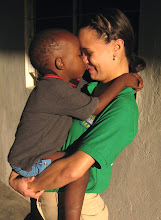
From my bedroom I can see the front yard of Lavinho and Akeisha, my very adorable 3 and 6 year old neighbors. When they are playing outside, I can lean back in my desk chair and yell at them to stop sucking on their grimy fingers, which is sort of like the chastising voice of an invisible god, since they can’t see me through the window screen. Lavinho and Akeisha’s father is Daniel, a fellow English teacher who works for the school five hours a week. Daniel’s wife had a baby two weeks ago, contributing to the never-ending supply of newborns I seem to be holding and taking pictures of and buying presents for.
I grow Marigolds in hanging pots beside our front door, which is how you can recognize our house in a long block of connected teacher’s houses that all share walls with their neighbors.
I will leave Mozambique in December, probably forever. I don’t know how many Peace Corps volunteers succeed to go to back to visit their countries of service or be recognized by the people they used to work with. I think I will cry. I think Lavinho and Akeisha might cry too, but my Mother, who calls every week from California, says that children get over things quickly.
I finally bought a very cheap gold-colored ring to bolster my claim that I am married. I feel I could never marry a Mozambican and the only way I have succeed to say this not cruelly and effectively is to convince them I already have a husband. I wear the ring, which has a pretty little stone, even inside the house.
The main reason I consider no Mozambican men eligible is because I do not live in Mozambique. In less than a year’s time, my visa will expire and my house will be turned over to someone else and I will be living in a country where grapes can be eaten in the same region where they are grown. The fact that all this will happen is not probable, it is definite. I will leave Mozambique and I will go to America. And when I go to America I will face the significant stress of finding a new house, a new job, new friends, and do not think I could imagine succeeding to handle the additional stress of helping a Mozambican husband adapt to the craziness that is the developed world with its thousands of Olympians.
Every detail here is the setting of my life, but it is not actually my life and it is not actually me. It is a postcard of the things I experience but not sincerely what I live. In a way, it feels like a charade of non-reality, where I am accepted and even loved as though I am not transient, when I mostly certainly am. I cannot expect that the relationships I have now will still exist five years from now and I cannot expect that any of the connections with colleagues will lead to any sort of future opportunities. These years in Mozambique feel to me like an isolated cell of my life and not merely more time in a harmonious flow.
The Peace Corps catchword is “integration” which despite being in many ways an undefined cliché, I feel I have achieved. I know everyone inside the wall and several outside, I have friends through random encounters in Maputo, and I know everyone I buy anything from, including photos and vegetables. All of these moments of connection, however, feel like making love to someone you know you will leave. It’s not fair to let them get attached so you hold back the most genuine part of yourself.
Friday, March 19, 2010

Cows blood vs. Corn Flakes
Seemingly every semester my housemate, Katie, delivers the bad news: she has to save money to travel and therefore cannot buy food anymore. Regardless, this does not stop the flow through our cement block African house of watermelon and grapes, chicken and ground beef, olive oil and jam, corn flakes and granola, nor her requests for shrimp and brown rice. We still have Parmesan cheese and milk, we still make naan bread and tortillas, and when I have a can of evaporated milk from the States, I will stir up an Alfredo sauce. I freeze sausage to save for pizza when I have a chance to go to the city again to buy cheese, which will be combined with a yeast crust and very thinly sliced tomatoes. I will trek fifty miles with bread from the capital, since it’s whole wheat or really soft or particularly fresh. Katie will become so enamored with the bread as to do the same, although it faces the significant risk of getting smashed on the long bus ride home. We gave up margarine a long time for real butter and dip our carrots into creamy Caesar dressing from South Africa. I have developed a particular affinity for ketchup, which I eat with potatoes fried until they are crispy.
Since we are foreigners in a land that is not our own, we do what other foreigners in strange places do: Food is one possible means by which to preserve a satisfying part of your own culture. This why the Indians in California bring spices packed into their suitcases, why the Chinese flock to specialty stores for fish-flavored rice crackers. When no one is like you nor understands exactly what you are, you can still be yourself when you face your dinner plate.
Mozambicans do not drink cow’s blood, one of the horrors I was spared from facing when coming to Africa. Overall, food is not horribly painful, only a little. I am still uncertain if they eat cow’s brain, which I know is removed from the cow’s head, perhaps to be thrown out, perhaps to be cooked separately. The cow’s head is by all means, eaten. I have both tried it and helped prepare it. A cow’s head lying the market place is in fact a very common site. One day I discovered cow testicles draped over a severed cow’s neck, which I imagined implies that testicles are eaten as well. Mozambicans suck the ligaments off chicken’s feet in wedding soup and sometimes they clean the yellow muck from inside the chicken’s intestines and make soup out of them, too. All butchers sell hooves and livers and other organs I cannot identify, sitting in little open-air, fly-covered piles. Fish heads are consumed, little white fish eyeballs and all, but usually the tiny fish is cut in half and shared between two people so I request the tail. Meat is almost never served in terms of steak and fish fillets and boneless chicken breast.
Vegetarians can opt for white corn meal porridge, or rice, which is the cheap, sticky, fat-grained kind, or a variety of green curries made with ordinary leaves. Leaf consumption in the United States is usually limited to flavorful herbs, cabbage, and crisp lettuces, but in Mozambique, anything that is not poisonous or too tough or extremely bitter will be pounded up, mixed with salt and coconut milk, and eaten. Some if it is still fairly bitter. They call these dishes “yangana” and “matapa” and “couve,” and “aboubora” but they all more or less taste the same with only some variance between mildly sweet and painfully bitter. The typical diet is rounded out with white bread, watery bean dishes, and tea with brown sugar.
I have, for many years, eaten nearly everything that can be chewed and swallowed. I marvel at the oddity of adults who refuse to eat harmless things like tomatoes and myself keep a very short list of things I will chose to pass up, like Brussel sprouts and beets. In this way, Africa suits me well, and with the assistance of only a mild dose of hunger, I can almost always clean my plate, no matter what it contains. I do, however, draw a distinct line between consumable (nearly everything) and enjoyable (desserts with nuanced sweetness, meat marinated into spicy savoriness, warm, dry rice…)
In my generally very ascetic life, food is my primary source of fleshly pleasure, and I can fantasize about life where restaurants of every type line the streets and brownies are a mere instant grocery store mix away!
Since we are foreigners in a land that is not our own, we do what other foreigners in strange places do: Food is one possible means by which to preserve a satisfying part of your own culture. This why the Indians in California bring spices packed into their suitcases, why the Chinese flock to specialty stores for fish-flavored rice crackers. When no one is like you nor understands exactly what you are, you can still be yourself when you face your dinner plate.
Mozambicans do not drink cow’s blood, one of the horrors I was spared from facing when coming to Africa. Overall, food is not horribly painful, only a little. I am still uncertain if they eat cow’s brain, which I know is removed from the cow’s head, perhaps to be thrown out, perhaps to be cooked separately. The cow’s head is by all means, eaten. I have both tried it and helped prepare it. A cow’s head lying the market place is in fact a very common site. One day I discovered cow testicles draped over a severed cow’s neck, which I imagined implies that testicles are eaten as well. Mozambicans suck the ligaments off chicken’s feet in wedding soup and sometimes they clean the yellow muck from inside the chicken’s intestines and make soup out of them, too. All butchers sell hooves and livers and other organs I cannot identify, sitting in little open-air, fly-covered piles. Fish heads are consumed, little white fish eyeballs and all, but usually the tiny fish is cut in half and shared between two people so I request the tail. Meat is almost never served in terms of steak and fish fillets and boneless chicken breast.
Vegetarians can opt for white corn meal porridge, or rice, which is the cheap, sticky, fat-grained kind, or a variety of green curries made with ordinary leaves. Leaf consumption in the United States is usually limited to flavorful herbs, cabbage, and crisp lettuces, but in Mozambique, anything that is not poisonous or too tough or extremely bitter will be pounded up, mixed with salt and coconut milk, and eaten. Some if it is still fairly bitter. They call these dishes “yangana” and “matapa” and “couve,” and “aboubora” but they all more or less taste the same with only some variance between mildly sweet and painfully bitter. The typical diet is rounded out with white bread, watery bean dishes, and tea with brown sugar.
I have, for many years, eaten nearly everything that can be chewed and swallowed. I marvel at the oddity of adults who refuse to eat harmless things like tomatoes and myself keep a very short list of things I will chose to pass up, like Brussel sprouts and beets. In this way, Africa suits me well, and with the assistance of only a mild dose of hunger, I can almost always clean my plate, no matter what it contains. I do, however, draw a distinct line between consumable (nearly everything) and enjoyable (desserts with nuanced sweetness, meat marinated into spicy savoriness, warm, dry rice…)
In my generally very ascetic life, food is my primary source of fleshly pleasure, and I can fantasize about life where restaurants of every type line the streets and brownies are a mere instant grocery store mix away!
Subscribe to:
Comments (Atom)