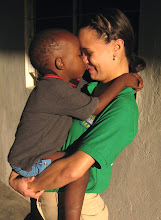
If I were asked to define love as a single emotion or force of motivation, I could not do it. I could nothing more than to list a general set of correlating characteristics, supporting the definition only in a vague and insuccinct manner. It was with this same level of understanding that in the Summer of 2008, I put the word “love” as the center of my e-mail address, my own name as the subject, and “Africa” as the object. “Anna loves Africa.” A few months later I left everything and boarded a South African Airways flight departing from the JFK airport in New York City to take me 10,000 miles away to the African country of Mozambique. I was not going for a safari, for study abroad semester, or for a brief internship. I would be staying for over two years, rebuilding my life there and sacrificing any certainty of what would be left for me in the United States when I returned.
My friend Eliza looks a little bit like the Grinch, but only in the very cutest way. She has very long eyelashes and very wide eyebrows and little nose that makes her eyes look bigger and her eyelashes longer. On one extremely hot day in Southern-Hemisphere February I noticed her mother. Eliza’s mother cannot walk so she crawls, her knees wrapped it fabric, one foot falling behind her, the other bent towards the left. This makes her arms and shoulders disproportionately muscled, and her hands exceptionally calloused. Her back is severely arched and her full stature is only two feet. Eliza’s mother was sitting near the gutter as I passed, on my way to the village market to buy potatoes and carrots, and I did not consider it appropriate to stare at a crippled woman. I wouldn’t have stopped if it weren’t for Eliza, standing nearby in a sun hat and a flowered skirt. I smiled at her because she was too cute not to smile at. I bent down and greeted her. “It’s a very sad story,” said the man standing near us, to me in English which no one else understands. “Her mother was sexually harassed.”
The next week at the market I saw a woman give Eliza one Metecal to buy a Popsicle. A passing man thrust 20 Metecais at her mother. I picked up Eliza, calling her “my little sweetheart” in Portuguese, and helped her open her Popsicle. When I put her down, she held on to my legs, so picked her up again, orange Popsicle juice dripping onto us. I was so busy helping my little friend enjoy her treat that I didn’t notice a fifteen or twenty person crowd had gathered to gawk at the interesting trio: a disabled mother, a little girl, and a young white woman. I put Eliza down. Her sucking was becoming less fruitful as she has reached the very frozen center of the Popsicle. Some people walked away. I bent down, patted her sun hat covered head, and told Eliza that I will visit her next week.
And that is how I love Africa. Not by writing policy, developing programs or by donating funds. I teach English. And I feed Popsicles to a little girl whose father is a rapist and whose mother can’t pick her up. It’s so simple, it’s almost trivial. No one could call it “saving the world” and no one will give me any sort of prize for doing what I mostly do, which is talk to people, visit their houses, and adore their children.
If love is defined as ongoing dedication, a sustained commitment, than I do not love Africa. My time here will be enough to show me that development work is not for me; it is not for most people. It is filled with infinite frustrations and roadblocks that make work difficult and disappointing. I have neither the spirit of Pollyanna nor the single-minded drive of Attila the Hun that could make survive in this kind of work forever. Love for me at the moment is passing moments of warmth, small encounters, fleeting and sweet connections.